Overview
In Lessons 1.4 and 1.5 you learned how to measure a model: sensitivity, specificity, PPV, and the shortcuts that can fool them. Those numbers answer one question: does the tool find the disease? This lesson asks the questions that come next. About 15-20 minutes.
By the end of this lesson you can:
- Explain why accuracy is only an early rung of evidence.
- Place a claim about an AI tool on the ladder of evidence.
- Give two reasons a tool that worked in a study can fail at your hospital.
- List the costs and benefits a hospital should weigh before buying a tool.
The ladder of evidence
In 1991, Fryback and Thornbury described how to judge any imaging test as a ladder. Each rung asks a harder question, and each needs a harder study to answer it. AI tools are imaging tests too, so the same ladder applies. Step through it with the nodule-detection AI from Lesson 3.1.
One of the highest-rung AI studies so far is the MASAI trial in Sweden (Lång et al., 2023). More than 80,000 women having screening mammograms were randomly assigned to standard double reading by two radiologists, or to AI-supported reading where AI sorted the low-risk exams to a single reader. The AI group found more cancers, with no rise in false positives, and radiologists read about 44% fewer screens. Even so, the key outcome for patients (fewer cancers found between screens, later) needed further follow-up.
Which rung is this claim?
Company websites and news headlines often make AI claims. Decide which part of the ladder each claim really reaches.
Will it work here?
A study tells you how a tool did at the hospitals in the study. Your hospital may be different. Testing a tool on data from a place it was not built at is called external validation, and tools often do worse there. Common reasons:
- Different machines and settings. A new CT scanner brand or a different scan protocol can change the image just enough to confuse a model.
- Different patients. Age, ethnicity, body size and other diseases may differ from the training data.
- Different prevalence. If the disease is rarer at your hospital, more of the alerts will be false alarms, even with the same sensitivity and specificity.
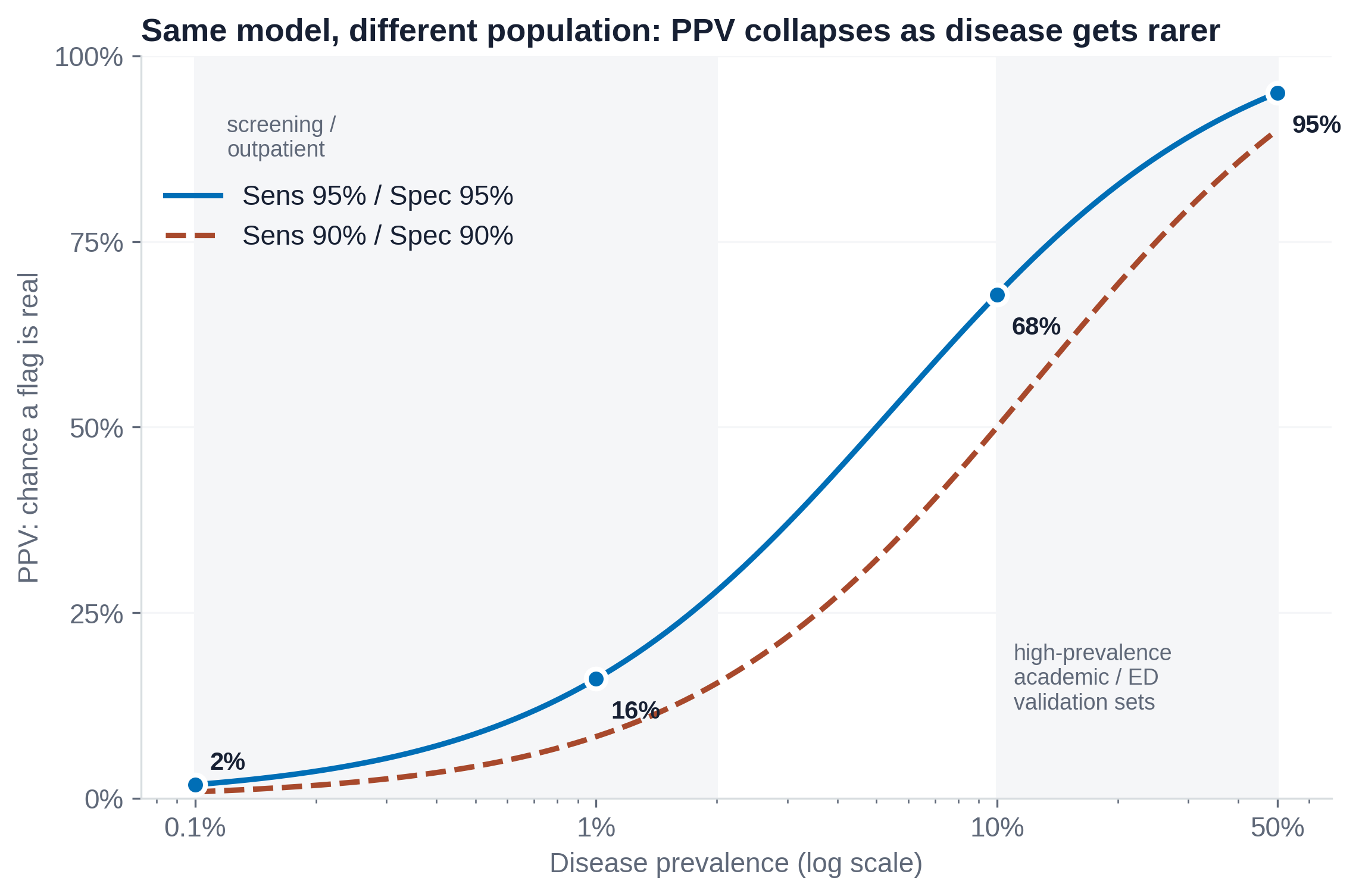
Each square is one of 1,000 patients scanned with the same AI tool. Slide from a screening clinic, where the disease is rare, to an emergency department, where it is common. Watch what happens to the false alarms.
A sepsis prediction model built into a common health-record system was used in hundreds of hospitals. When researchers at one hospital tested it on their own patients, its AUROC was 0.63, far below what the developer reported. It missed about two thirds of sepsis cases and alerted on many patients who did not have sepsis (Wong et al., 2021). The lesson: check a tool on your own patients before trusting it, and keep checking after it goes live, because hospitals and patients change over time.
Is it worth it?
Even a tool that works has costs. Before buying one, a hospital weighs both sides.
| Possible benefits | Possible costs |
|---|---|
| Urgent findings read sooner (Mr. Diaz's clot) | The software price, IT setup and upkeep |
| Fewer missed findings | Radiologist time spent checking false alarms |
| Less reading time on simple cases | Extra follow-up scans and biopsies for findings that did not matter |
| More consistent measurements | Staff training, and monitoring the tool after go-live |
| Follow-ups that do not get lost | Skills that fade if people stop practicing (Lesson 3.3) |
Notice that the benefits and costs often fall on different people. The hospital pays for the software, the radiologist clears the false alarms, and the patient lives with the extra scan. A good decision looks at all of them.
Knowledge check
Answer each question to continue. Any answer is fine; read the explanation.
A company says its fracture AI is FDA-authorized and has an AUROC of 0.95. What has it shown so far?
Authorization and AUROC show accuracy, the second rung. Patient benefit and performance at your hospital are separate questions that need separate evidence.
A tool built in a busy emergency department is moved to an outpatient screening clinic where the disease is much rarer. Sensitivity and specificity stay the same. What happens?
PPV depends on prevalence. When the disease is rarer, a larger share of positive alerts are false, so the same tool creates more work for each true finding.
Which study would best show that an AI tool helps patients?
Only a study that follows patients, ideally randomized, can show a difference in outcomes. Image tests show accuracy and surveys show opinion.
Key takeaways
- Accuracy is the second of six rungs. Patient outcomes and value sit at the top, and few AI tools have reached them.
- FDA authorization mostly reflects accuracy evidence, not proof of patient benefit.
- Tools often do worse at new hospitals: different machines, different patients, different prevalence. Test locally and keep monitoring.
- Weigh benefits against costs, including false alarms, extra scans and staff time, and notice who bears each one.
Go further (optional)
- Fryback & Thornbury, The efficacy of diagnostic imaging (Medical Decision Making, 1991)
- Lång et al., the MASAI trial of AI-supported mammography screening (Lancet Oncology, 2023)
- Wong et al., External validation of a widely implemented sepsis prediction model (JAMA Internal Medicine, 2021)
- AI Tool Tracker (what is authorized, by specialty and year)